


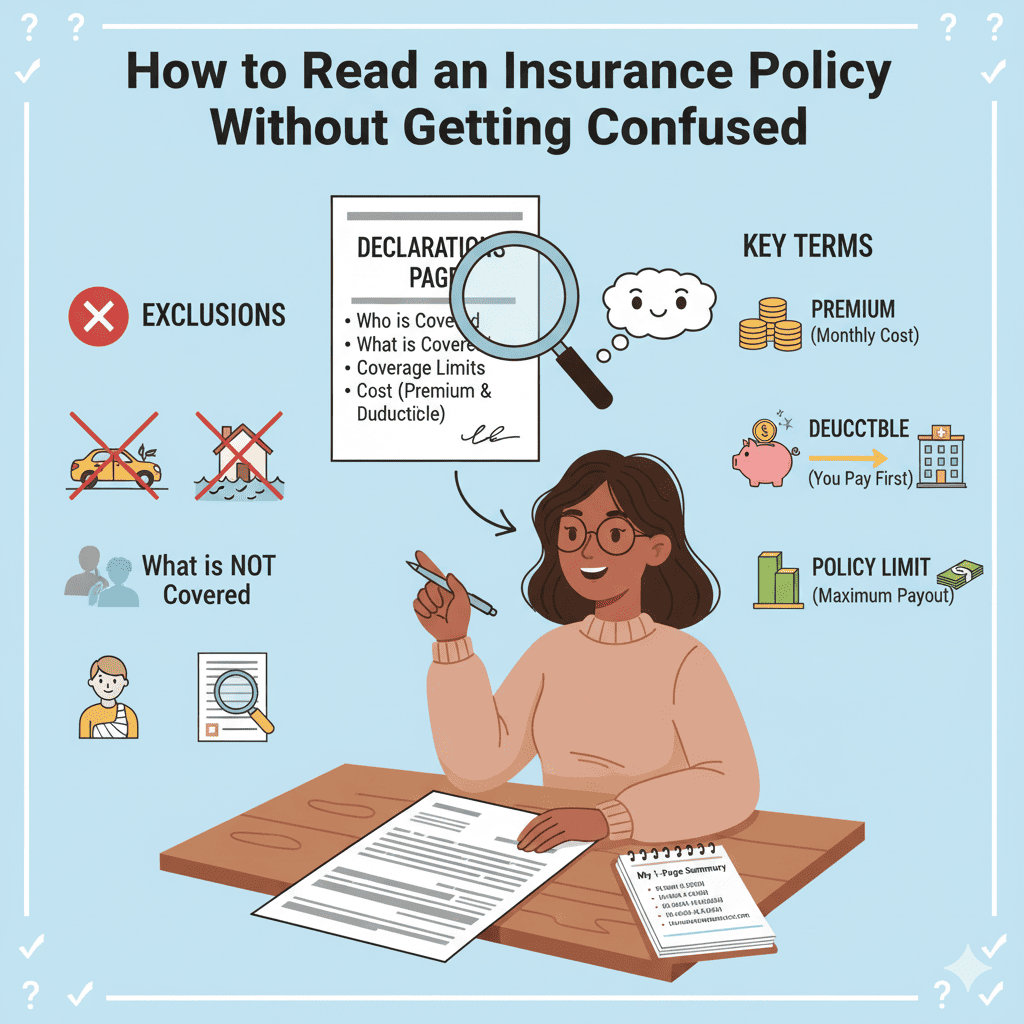
Don’t worry. You are not alone, and you absolutely do not need to read every single word to understand what you’ve purchased.
Think of your insurance policy not as a scary legal contract, but as the “user manual” for your financial safety net. Your job isn’t to memorize it, but to know where to find the most important settings. This guide will teach you how to read an insurance policy by focusing on just a few key sections that truly matter.
The good news is that almost all understanding insurance documents comes down to knowing their basic structure. Whether it’s for your car, apartment, or health, policies are generally built the same way. Here are the four parts of your “user manual”:
That’s it! By knowing these four sections exist, you already have a mental map of your policy.
Before we walk through the steps, let’s learn a few key vocabulary words. Getting these right is half the battle. This is a mini-glossary of insurance terms for beginners.
Ready to tackle that document? Don’t start on page one. Follow this simple, three-step method to get straight to the information that matters most.
This is your new best friend. The policy declaration page is usually the very first page of your policy, and it’s your personalized cheat sheet. It summarizes all the critical information in one place. If you read nothing else, read this page carefully.
It will tell you:
This one page answers 90% of the questions most people have about their coverage.
This might sound backward, but this is a pro tip. Before you dive into the long pages describing what’s covered, flip to the insurance exclusions explained section to see what is NOT covered.
Why? Because it manages your expectations. Knowing that your homeowners insurance doesn’t cover flood damage, or your auto policy doesn’t cover mechanical breakdowns, is critical information. Reading the exclusions prevents a lot of frustration and disappointment if you ever have to file a claim.
Go back to your Declarations Page and look closely at the policy limits. Ask yourself a simple question: “Is this number enough?”
Your policy limits define the ultimate value of your safety net. Make sure they are high enough to give you real peace of mind.
Here’s a final piece of advice I give everyone. Once you’ve reviewed your policy, take five minutes and create your own one-page summary in your own words.
Grab a piece of paper or open a note on your phone and write down:
Save this somewhere you can easily find it, like in your phone’s contacts or taped inside a kitchen cabinet. In a stressful emergency, this simple sheet will be far more helpful than a 50-page document.
See? It’s not so scary when you know where to look. An insurance policy might seem intimidating, but it’s just a document. By ignoring the noise and focusing on the Declarations Page, Exclusions, and your Coverage Limits, you can get a solid grasp of your protection in less than 30 minutes.
By following these simple steps, you can confidently review any of your understanding insurance documents. You are now in control of your financial protection, and that is a great feeling.

Lead Researcher & Founder at LoveInsurance.biz. With an academic background in law (class of 2017), Nicolas specializes in deconstructing complex contract clauses and insurance policies, transforming legal jargon into clear, actionable advice for everyday consumers.