
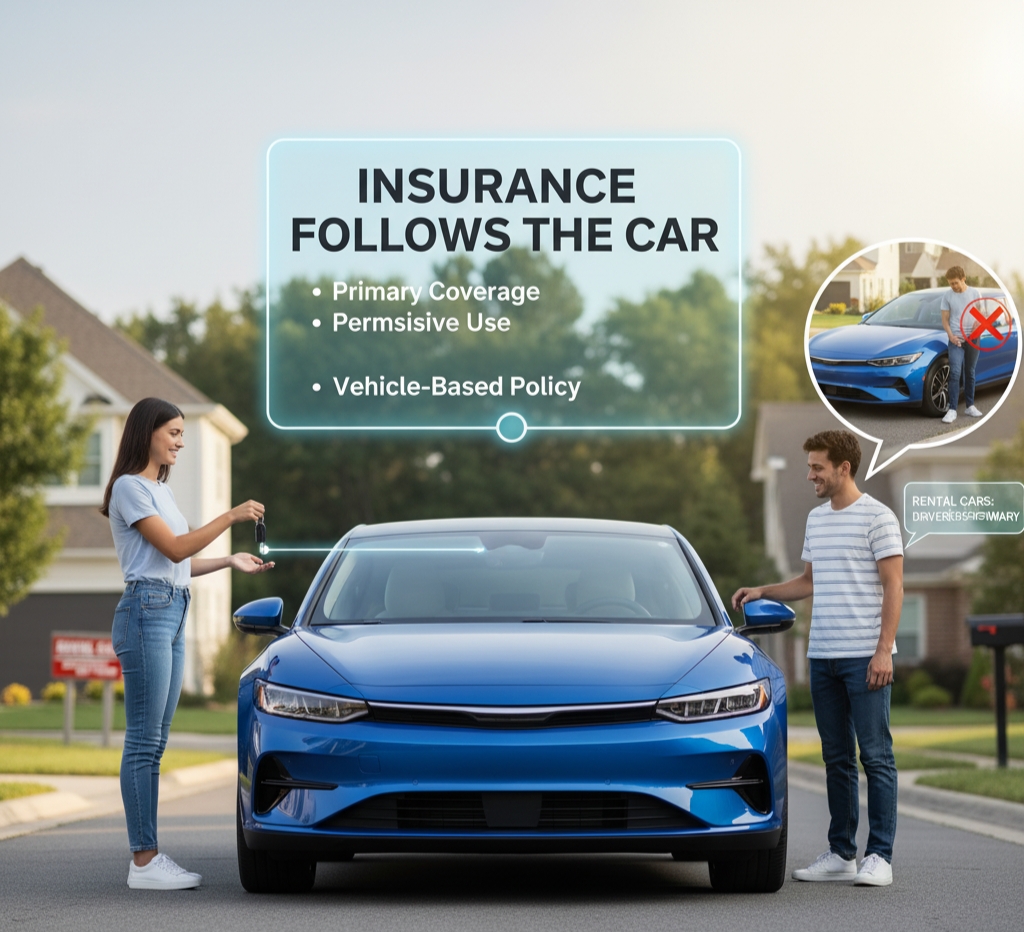
This might come as a surprise to many, but it’s crucial to understand. When you purchase an auto insurance policy, you are primarily insuring your vehicle against damage and insuring yourself against liability incurred while operating that vehicle. This means that if you lend your car to a friend, family member, or even a casual acquaintance, your existing auto policy is usually the one that steps up first in the event of an accident.
This guide will demystify this core concept, explore the common “permissive use” clause, walk through accident scenarios, and highlight the key exceptions you absolutely need to be aware of. By the end, you’ll have a crystal-clear understanding of who is responsible when you hand over your keys.
The Core Concept: “Permissive Use”
The foundation of “insurance follows the car” lies in a standard clause found in almost every auto insurance policy: “permissive use.”
What does “permissive use” mean in plain language? It means that if you, the named insured (the person whose name is on the policy), give someone permission to drive your vehicle, your insurance coverage extends to them. It’s as if they are temporarily covered under your policy, provided their use is indeed “permissive” and not a regular, unlisted occurrence.
Think of it this way: Your car is the primary entity being covered for potential damages (via collision or comprehensive coverage), and your policy’s liability coverage is designed to protect you financially if your vehicle causes harm to others, regardless of who is behind the wheel, as long as they had your permission.
Example: You let your friend, Sarah, borrow your car to pick up groceries because her car is in the shop. While driving your car to the store, Sarah accidentally backs into a pole in the parking lot. Whose insurance pays for the damage to your car and potentially the pole? Yours. Because you gave Sarah permission to drive, your policy’s collision coverage would pay for the damage to your car (minus your deductible), and your property damage liability would cover the pole.
This principle is designed to offer broad protection. Insurers understand that it’s common for people to occasionally lend their cars to others. They build this expectation into their policies and pricing.
What Happens if Someone Else Wrecks My Car?
This is the scenario most people worry about. You’ve been generous enough to lend your car, and then you get that dreaded call. So, what happens if someone else wrecks my car? Here’s the breakdown:
1. Your Insurance Pays First (Primary Coverage)
In the vast majority of cases where you’ve given permission, your auto insurance policy will be the primary payer.
- Damage to Your Car: Your collision coverage will kick in to pay for the repairs to your vehicle, minus your deductible. For example, if the repairs cost $5,000 and your deductible is $500, your insurance company will pay $4,500. This is true even if your friend was at fault.
- Damage to Others’ Property: Your property damage liability coverage will pay for any damage your friend caused to other vehicles, property (like fences, mailboxes, etc.), or structures.
- Injuries to Others: Your bodily injury liability coverage will pay for medical expenses, lost wages, and other damages for anyone injured in the other vehicle or, in some cases, pedestrians.
Important Note on Your Rates: Yes, if your friend causes an accident while driving your car, it will likely go on your insurance record and could cause your premiums to increase. This is a tough pill to swallow for many car owners but is a direct consequence of “insurance follows the car.” You are responsible for who you allow to drive your insured vehicle.
2. Their Insurance Might Pay Second (Secondary Coverage)
What if the accident is severe, and the damages exceed your policy’s limits? This is where the driver’s own insurance might come into play.
If your friend, Sarah, has her own auto insurance policy, that policy could act as secondary coverage.
- Example: Sarah causes an accident that results in $75,000 in property damage, but your policy only has a $50,000 property damage limit. Your insurance would pay the first $50,000. Sarah’s personal auto liability coverage would then be expected to cover the remaining $25,000.
This situation is less common because most people carry sufficient liability limits. However, it highlights why it’s a good idea to only lend your car to someone who also has their own insurance coverage and is a responsible driver.
When Your Insurance Doesn’t Follow the Car (The Exceptions)
While “insurance follows the car” is the golden rule, there are critical exceptions where your policy might not cover an accident, or coverage could be significantly impacted. Being aware of these can save you a world of trouble.
- Excluded Drivers: This is a major exception. If you have explicitly listed someone on your policy as an “excluded driver” (often done to save money if you live with a high-risk driver you don’t want covered), your insurance company will not cover any damages or liability if that specific person is driving your car and gets into an accident. In this scenario, the excluded driver would be personally responsible for all damages, and your insurance company would deny the claim.
- Regular, Unlisted Drivers: This is a common point of contention with insurers. If someone regularly drives your car – for instance, a roommate who uses it for their commute, a nanny, or a child who lives with you – but they are not listed on your policy, your insurance company could deny a claim. Insurers expect all regular drivers of a vehicle to be listed on the policy and rated accordingly. If you fail to do this, they might view it as misrepresentation or an attempt to avoid higher premiums. This is why it’s vital to inform your insurer about anyone who frequently uses your vehicle.
- Non-Permissive Use (Theft): If someone takes your car without your permission (e.g., it’s stolen), your insurance generally still covers the car itself. Your comprehensive coverage would pay for the theft or damage to your vehicle resulting from the theft. However, your liability coverage would not extend to the thief. If the thief causes an accident, your liability coverage would not apply to their actions because they did not have your permission to drive the car. The thief would be personally liable.
- Using Your Car for Commercial Purposes: If you lend your car to someone who then uses it for commercial activities like ridesharing (Uber, Lyft), food delivery, or other business purposes (even if they have “permissive use” for personal driving), your personal auto policy will almost certainly deny coverage in the event of an accident during that commercial use. Personal auto policies have specific exclusions for commercial activity. If your car is being used commercially, it requires a commercial auto insurance policy.
- Intentional Acts: If the driver intentionally causes an accident or damage, insurance policies typically do not cover intentional acts. This is usually criminal activity and not covered by standard liability or collision.
So, Does Insurance Follow the Car or the Driver in These Cases?
This question brings us to specific situations where the lines blur, or where the “driver’s” insurance might actually take the lead. This is where the answer to does insurance follow the car or the driver gets more nuanced.
Rental Cars: When the Driver’s Insurance Can Be Primary
When you rent a car from a commercial rental agency, the situation changes significantly. In this case, your personal auto insurance policy usually extends to cover the rental car as if it were your own. This means:
- Your Collision/Comprehensive: If you have these coverages on your personal policy, they would typically cover damage to the rental car.
- Your Liability: Your personal liability coverage would protect you if you cause an accident in the rental car.
This is where the question does my insurance cover rental cars becomes highly relevant. For most drivers with full coverage on their personal vehicle, their policy does extend to rental cars for personal use.
However, you still have options:
- Rental Car Company’s Collision Damage Waiver (CDW/LDW): This waiver, purchased at the counter, absolves you of responsibility for damage to the rental car. It’s often redundant if your personal policy covers it, but can provide peace of mind or fill gaps.
- Credit Card Rental Car Benefits: Many credit cards offer secondary (or sometimes primary) rental car insurance benefits if you pay for the rental with their card.
In essence, with rental cars, while your personal auto policy (which covers your car) extends to you as the driver in the rental car, you are technically the “borrower” of the rental company’s vehicle. It’s a unique exception where the driver’s own policy often acts as primary for the rental.
Non-Owner Car Insurance: A Policy for the Driver
For individuals who frequently drive cars they don’t own (e.g., they regularly borrow friends’ cars, use car-sharing services, or need to fulfill an SR-22 requirement but don’t own a vehicle), there’s a specific type of policy called non-owner car insurance.
This policy is explicitly designed to follow the driver, not the car. It provides liability coverage for the policyholder when they are driving a vehicle they do not own. It does not provide collision or comprehensive coverage for the borrowed car itself, only protection against liability if the driver causes an accident.
This is a prime example of an insurance product that directly answers the question, “Does insurance follow the driver?” – in this specific, niche context, it absolutely does, for liability.
Conclusion
The question, does insurance follow the car or the driver, is a fundamental one that every driver should understand. While there are a few exceptions and specific scenarios like rental cars or non-owner policies, the golden rule to remember is that your auto insurance policy is primarily tied to your vehicle. When you lend your car, you are essentially lending your insurance coverage along with it.
This means that if someone with your permission gets into an accident while driving your car, it will almost always be your policy that responds first to pay for damages and injuries. This can have implications for your deductible and potentially your future premiums.
Before you hand over your keys, be sure you trust the person driving, not just with your vehicle, but with your financial responsibility. A quick conversation about safe driving and ensuring they have their own insurance (as a secondary backup) can provide significant peace of mind

Lead Researcher & Founder at LoveInsurance.biz. With an academic background in law (class of 2017), Nicolas specializes in deconstructing complex contract clauses and insurance policies, transforming legal jargon into clear, actionable advice for everyday consumers.
About the Author