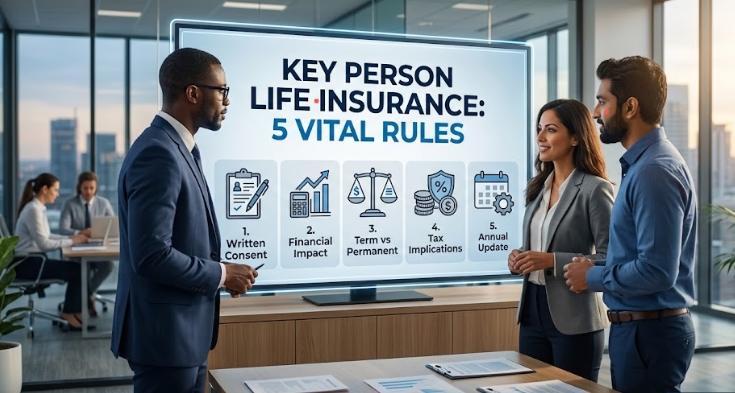
Key Person Life Insurance for Small Business: 5 Vital Rules in 2026
Starting and growing a business is rarely a solo journey, but there is almost always one individual whose skills, connections, or leadership are the glue holding everything together. It could be the charismatic founder, the brilliant lead developer, or the top salesperson bringing in 80% of the revenue. But what happens to the company if that indispensable person unexpectedly passes away?
The harsh reality is that without proper planning, the loss of a crucial team member can lead to immediate bankruptcy. This is exactly where key person life insurance for small business becomes the ultimate safety net. In this comprehensive 2026 guide, we will explore what this insurance is, why it is essential, and the rules you must follow to protect your enterprise.
Our Expert Business Perspective At LoveInsurance.biz, we look at insurance through the lens of legal protection and business survival. Having a background in law and firsthand experience in structuring digital and physical businesses, we know that standard general liability isn’t enough. You need to protect your human capital just as fiercely as you protect your physical assets.
1. What is Key Person Life Insurance?
Historically known as “key man insurance,” key person life insurance for small business is a standard life insurance policy purchased by a company on the life of an essential employee or executive.
The structure is simple but powerful:
-
The Business purchases the policy and pays the premiums.
-
The Business is the beneficiary.
-
If the key employee dies, the Business receives the death benefit payout.
This tax-free cash injection is designed to keep the company afloat while it navigates the crisis, pays off debts, reassures investors, or funds the expensive process of finding and training a replacement.
2. Who Exactly Needs This Coverage?
Not every employee needs to be insured. You should consider this policy for individuals whose sudden absence would cause an immediate and severe financial blow to operations. This typically includes:
-
Founders and co-founders.
-
Employees with highly specialized, hard-to-replace skills.
-
Executives who have personally guaranteed company loans.
-
The primary revenue generator (like a top-tier sales director).
3. A Real-World Scenario: The Agricultural Cooperative
To understand the true value of this policy, let’s look at a practical, large-scale scenario. Imagine managing a substantial agricultural operation, such as a milk production cooperative like Bab Sahراء, encompassing 90 active members and managing a herd of over 200 cattle.
The logistics, vendor relationships, and daily operations of such a complex organization often rely heavily on one primary managing director. If that leader unexpectedly passes away, the financial shock and operational chaos could jeopardize the livelihoods of all 90 members. A key person life insurance for small business policy injects immediate, liquid cash into the cooperative. This money can be used to hire an interim expert manager, settle outstanding supplier invoices, and keep the milk production running smoothly while the cooperative restructures.
4. The 5 Vital Rules for Key Person Insurance in 2026
If you are ready to secure your business’s future, here are the five rules you must follow:
-
Rule 1: Get Written Consent You cannot secretly buy a life insurance policy on an employee. The key person must be fully aware of the policy, understand the terms, and provide written consent before the policy goes into effect.
-
Rule 2: Calculate the True Financial Impact How much coverage do you need? A common rule of thumb is to calculate the financial loss the company would suffer over a period of 12 to 36 months without that person. Factor in lost sales, recruitment costs for a replacement, and potential loss of client confidence.
-
Rule 3: Choose Between Term and Permanent Most businesses opt for Term Life Insurance for key employees because it is cost-effective and covers the individual for the specific years they are most crucial to the company (e.g., a 10 or 20-year term). Permanent Life Insurance is more expensive but builds cash value, which the business can sometimes borrow against.
-
Rule 4: Understand the Tax Implications Unlike general liability insurance (which we covered in our article Is General Liability Insurance Tax Deductible), the premiums paid for key person life insurance are generally not tax-deductible. However, the death benefit paid out to the company is usually received entirely tax-free.
-
Rule 5: Keep the Policy Updated A business is a living, breathing entity. An employee who was “key” five years ago might have transitioned to a lesser role today, or you may have hired a new executive who is now indispensable. Review your key person policies annually alongside your corporate legal audits.
5. Can This Be Used for Business Partnerships?
Yes, but it is applied differently. If you have a business partner, you should pair key person insurance with a “Buy-Sell Agreement.” If your partner dies, the insurance payout provides you with the funds to buy out their share of the business from their grieving family, ensuring you retain control of the company without going into massive debt.
Conclusion: Securing the Irreplaceable
You can rebuild a damaged office, and you can replace a stolen laptop. But you cannot instantly replace the visionary leader or the master negotiator who built your company’s reputation. Investing in key person life insurance for small business is the ultimate testament to responsible leadership. It ensures that the legacy, jobs, and services your company provides will survive, no matter what tragedies occur.
“What steps have you taken to protect the irreplaceable people in your business? Share your thoughts in the comments below!”

Lead Researcher & Founder at LoveInsurance.biz. With an academic background in law (class of 2017), Nicolas specializes in deconstructing complex contract clauses and insurance policies, transforming legal jargon into clear, actionable advice for everyday consumers.