Top Open Source Insurance Agency Management Software: Is It Worth It?
Top Open Source Insurance Agency Management Software: Is It Worth It?
Running an independent insurance agency involves juggling client data, carrier appointments, and complex commission structures. For years, the only solution was to pay hefty monthly subscription fees for commercial, locked-down systems. However, as operational costs continue to rise in 2026, tech-savvy agency principals are actively looking for alternatives. If you are searching for insurance agency management software open source options, you are likely trying to escape the trap of expensive, per-user SaaS (Software as a Service) licenses.
But does a free, open-source platform actually exist for the complex world of insurance? And more importantly, is it secure enough to handle sensitive client financial data? Let’s dive into the reality of open-source solutions for independent agencies.
What is Open Source Insurance Software?
“Open source” means the original source code of the software is freely available to the public. Anyone can download, modify, and distribute it without paying licensing fees to a massive tech corporation.
In theory, an insurance agency management software open source system allows an agency to build a fully customized platform tailored exactly to their workflow. Whether your agents are running quotes on a dual-monitor setup or simply working remotely from a reliable company ThinkPad, a well-configured open-source web application runs smoothly without demanding expensive local hardware.
However, “free to download” does not mean “free to run.”
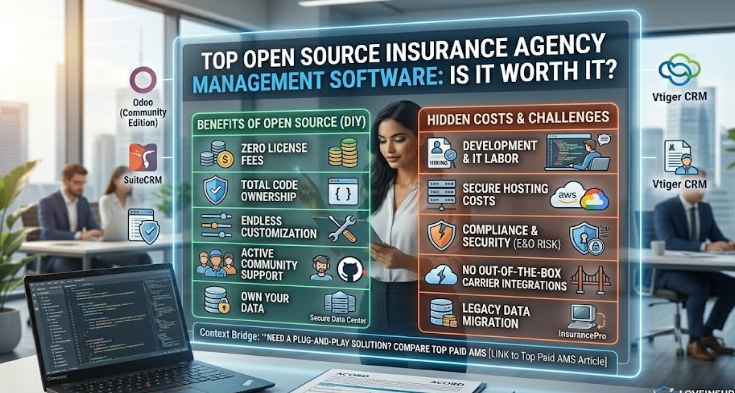
The Hidden Costs of Open Source Agency Systems
Before you cancel your current software subscriptions, it is critical to understand the trade-offs. Open-source software is incredibly powerful, but it requires a “Do It Yourself” (DIY) mindset.
1. Development and Customization Costs
There is currently no highly popular, out-of-the-box open-source AMS built specifically for insurance that competes with commercial giants. Instead, you have to take a generalized open-source CRM or ERP and hire a developer to customize it for insurance workflows (like tracking ACORD forms or carrier dec pages).
2. Hosting and Security
Commercial platforms handle server maintenance and data encryption. If you use an open-source solution, your agency is legally responsible for hosting the database securely and ensuring it complies with strict data privacy laws. You will need to pay for secure cloud hosting (like AWS or Google Cloud) and an IT professional to maintain it.
Top Open Source Alternatives to Consider
If you have the IT budget to customize a platform, here are the top open-source systems that can be adapted into a powerful agency management system:
1. Odoo (Community Edition)
Odoo is a massive, highly modular open-source ERP (Enterprise Resource Planning) system. While not exclusively for insurance, its open architecture allows developers to build specific modules for policy tracking, automated invoicing, and client portals. It is the closest thing to building your own enterprise-grade AMS from scratch.
2. SuiteCRM
If your primary goal is managing the sales pipeline and client relationships rather than backend carrier accounting, SuiteCRM is a fantastic alternative. It is a highly customizable, free open-source CRM that can be easily modified with custom fields to track policy expiration dates, coverage types, and household members.
3. Vtiger CRM (Open Source)
Similar to SuiteCRM, Vtiger offers a robust community edition. It excels in workflow automation. A savvy agency could configure Vtiger to automatically send out renewal reminder emails 30 days before a policy expires, effectively mimicking the behavior of a commercial AMS.
Open Source vs. Commercial AMS: The Verdict
If you are a large brokerage with an in-house IT department, utilizing an Open Source Insurance Agency Management Software framework like Odoo could save you tens of thousands of dollars annually in licensing fees. You own your data completely, and you own the code.
However, for 90% of independent agencies, the peace of mind provided by a dedicated commercial system is worth the price. Commercial systems come pre-loaded with carrier integrations, ACORD forms, and built-in comparative raters. If you want a plug-and-play solution without the headache of coding, we highly recommend reviewing our guide on the Top Insurance Agency Management Systems Ranked for 2026 to find a reliable, ready-to-use platform.
Conclusion
The allure of free software is strong, but in the insurance industry, compliance and data security cannot be compromised. Open-source platforms offer unparalleled freedom and customization for agencies willing to invest in development. But if your goal is to start selling policies immediately, sticking to dedicated, industry-specific software might be the safer, more profitable route.
Frequently Asked Questions (FAQ)
Is there a free, ready-to-use open-source AMS for insurance?
Currently, there is no major, ready-to-use open-source AMS that rivals commercial platforms out-of-the-box. Most agencies must download an open-source CRM (like SuiteCRM) and customize it extensively for insurance purposes.
Is open-source software safe for client data?
Yes, open-source code is often very secure because thousands of developers worldwide review it for vulnerabilities (you can view many projects on platforms like GitHub). However, the hosting environment you choose to put it on must be secured by your own IT team to ensure compliance with privacy laws.
Can open-source software integrate with comparative raters?
Out of the box, no. To connect an open-source CRM with your rating software, you would need to hire a developer to build a custom API integration to bridge the two systems.

Lead Researcher & Founder at LoveInsurance.biz. With an academic background in law (class of 2017), Nicolas specializes in deconstructing complex contract clauses and insurance policies, transforming legal jargon into clear, actionable advice for everyday consumers.