A Guide to Group Life Insurance for Small Business Owners (2026)
The bottom line is simple: offering group life insurance for small business employees is the single most cost-effective benefit you can provide to attract top talent and retain your best workers in 2026. While health insurance premiums continue to skyrocket, a foundational group life policy provides immense financial security to your team’s families for just a few dollars per employee each month. Here is your direct guide to understanding, pricing, and implementing this crucial coverage.
What is Group Life Insurance?
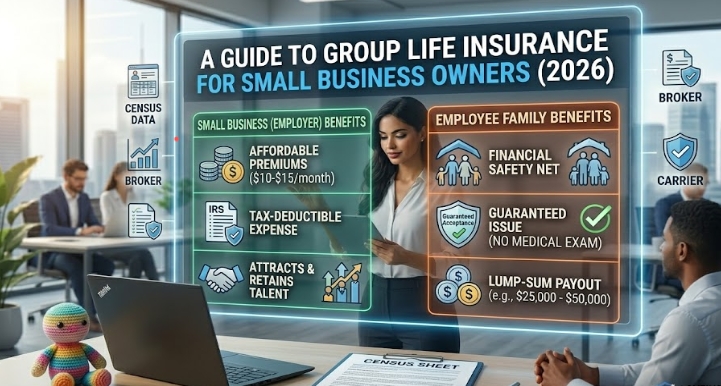
Group life insurance is a single contract covering an entire group of people—in this case, your employees. As the employer, you purchase the master policy and offer certificates of coverage to your eligible staff. Typically, this comes in the form of a base death benefit, such as a flat $25,000 to $50,000 per employee, or a multiple of their annual salary (e.g., 1x or 2x their base pay).
If an employee passes away while employed by your company, their designated beneficiaries receive a tax-free lump sum payout to cover funeral costs, mortgage payments, or everyday living expenses.
Why Offer Group Life Insurance for Small Business Employees?
You might wonder if adding another expense is worth it for a growing company. The return on investment (ROI) for this specific benefit is massive for three primary reasons:
1. Highly Affordable Premiums
Unlike individual life insurance policies that are priced based on a single person’s specific health risks, group life pools the risk of your entire staff. This wholesale approach makes the premiums incredibly cheap. On average, an employer might pay between $10 to $15 per employee, per month, for a standard $50,000 policy.
2. Guaranteed Issue (No Medical Exams)
One of the biggest hurdles to getting individual life insurance is the medical underwriting process. Group policies almost always offer “guaranteed issue” coverage up to a certain limit. This means your employees will not have to take a blood test, answer complex health questionnaires, or be denied coverage due to pre-existing conditions.
3. Tax Deductibility for Employers
The government actually incentivizes you to protect your workers. According to the Internal Revenue Service (IRS), the premiums you pay for the first $50,000 of group term life insurance coverage per employee are generally considered a tax-deductible business expense. This effectively lowers the true cost of offering the benefit.
How Much Does It Cost the Employer?
The exact cost of group life insurance for small business depends on the demographics of your team. Insurance carriers will look at:
-
Average Age: A younger workforce will generate lower premium rates.
-
Industry Type: High-risk industries (like construction) will see slightly higher rates than low-risk environments (like an accounting firm).
-
Coverage Amount: Offering a flat $25,000 is cheaper than offering a 2x salary multiplier.
-
Ratio of Male to Female Employees: Statistically, life expectancy affects the base rates.
How to Set Up Your Policy
Do not try to navigate carrier contracts alone. The fastest way to implement this is to partner with an independent insurance broker. Because brokers work for you and not the insurance companies, they can take your employee census data (a simple spreadsheet of ages and genders) and shop it across multiple top-tier carriers like Mutual of Omaha, MetLife, or Principal to find the most competitive rate.
Conclusion
Building a loyal, dedicated team requires showing them that you care about their long-term well-being and their families. Implementing group life insurance for small business is not just a nice perk; it is a strategic business move. It is highly affordable, entirely tax-deductible, and provides unparalleled peace of mind that keeps your employees focused on growing your company.
Frequently Asked Questions (FAQ)
What happens to the group life insurance if an employee quits or is fired?
Group life insurance is tied to employment. If an employee leaves the company, their coverage under the master policy terminates. However, most policies offer a “conversion privilege,” allowing the departing employee to convert their group coverage into an individual whole life policy within 31 days without taking a medical exam (though they will have to pay the new, individual premium themselves).
Do I have to offer group life insurance to every single employee?
No, but you must adhere to non-discrimination testing. Typically, you must offer it to all full-time employees (usually defined as working 30+ hours a week). You cannot selectively offer it only to your executives or highly compensated employees without facing strict tax penalties.
Can employees buy more coverage if they want it?
Yes, many plans offer “Supplemental Life Insurance.” The employer pays for the base amount (e.g., $50,000), and employees have the option to purchase additional coverage (e.g., an extra $100,000) through payroll deductions at the group’s discounted rate.

Lead Researcher & Founder at LoveInsurance.biz. With an academic background in law (class of 2017), Nicolas specializes in deconstructing complex contract clauses and insurance policies, transforming legal jargon into clear, actionable advice for everyday consumers.