
Car Break-In? 5 Steps to Prove Stolen Items for Renters Insurance
Car Break-In? 5 Steps to Prove Stolen Items for Renters Insurance
It’s a horrific experience. You return to your locked car only to find the passenger window is shattered. Glass fragments glisten on the pavement, and your backpack—with your camera gear inside—is gone. You are violated and frustrated, and your immediate question is: “Who is going to pay for this?” If you are wondering how to prove stolen items from car for renters insurance to your provider, you have come to the right place. Filing a successful claim isn’t about being in the right; it’s about providing the right evidence. Without substantiation, your adjuster can’t approve a payout.
How to Prove Stolen Items From Car for Renters Insurance: The 5 Essential Steps
Insurance companies don’t just hand out money. They require concrete proof that you owned the items you claim were stolen, and that the theft actually occurred. Here is the step-by-step process that we, at LoveInsurance.biz, recommend for digital-era claims.
1. File a Police Report immediately This is the single most important step. Before you make any insurance phone call, dial the non-emergency police line. An official police report is the foundational document for your claim. It proves that a crime occurred on a specific date, time, and location. According to authoritative sources like the Insurance Information Institute, you will universally be required to provide a police report number to process a theft claim. Be sure to list every stolen item for the officer to include in the report.
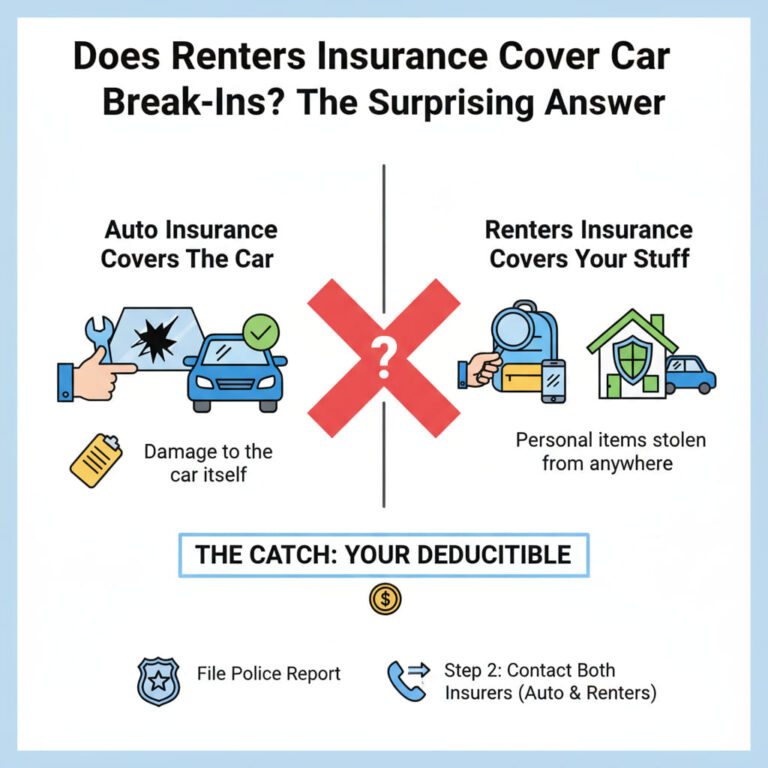
2. Document the Scene of the Break-In Before you clean up the glass, take clear, detailed photos and videos of the damage to your car. Your auto insurance covers physical damage like broken windows (as we detailed in our main guide, Does renters insurance cover car break ins), but your renters insurance adjuster still needs to see these photos to validate that a forced entry theft occurred. Capture the shattered window, any damage to the door lock, and a photo of the entire area.
3. Gather Proof of Ownership: Receipts and Statements The easiest way to prove you owned a laptop, a designer bag, or a piece of jewelry is with a receipt. If you bought an item in a store, look through your financial records to find the transaction on a bank or credit card statement. If you purchased it online (e.g., from Amazon or Etsy), check your email for the digital receipt. This documentation is crucial because it helps the adjuster establish the item’s purchase date and price, which are used to calculate its depreciation.
4. Find Digital Footprints and Photos What if you paid in cash and don’t have the receipt? You can still build a powerful case.
-
Registered Serial Numbers: Check your cloud accounts. If a high-value item like a phone, tablet, or gaming console was stolen, your serial number is likely registered with your manufacturer account (e.g., Apple iCloud, Google account, or Microsoft account).
-
Photographic Proof: Comb through your phone’s camera roll or social media. A photo of you using the stolen camera on vacation or wearing the stolen headphones at a coffee shop is excellent secondary proof of ownership.
-
User Manuals/Boxes: Do you still have the owner’s manual or the original product box? These items often have the serial number or unique ID, providing powerful circumstantial evidence of your ownership.
5. Submit a Detailed, Specific Inventory List When you formally contact your insurance agent, do not just tell them, “Thieves stole my backpack.” You must be precise. Your inventory list should look like this: “One 2024 Apple MacBook Pro 14-inch, Space Gray, 512GB, Serial Number ABC123XYZ456.” The more detail you provide, the easier it is for your adjuster to calculate its value and quickly approve the reimbursement.
Conclusion
Filing a successful claim after a break-in is a test of preparation. Knowing how to prove stolen items from car for renters insurance is not about waiting for a tragedy to occur; it is about building your proof today. By immediately filing a police report, gathering photographic evidence, and utilizing digital footprints, you turn a devastating experience into a successful claim, ensuring you recover your financial losses and get back to business.

Lead Researcher & Founder at LoveInsurance.biz. With an academic background in law (class of 2017), Nicolas specializes in deconstructing complex contract clauses and insurance policies, transforming legal jargon into clear, actionable advice for everyday consumers.