
Top 10 Worst Medicare Supplement Companies to Avoid: Red Flags
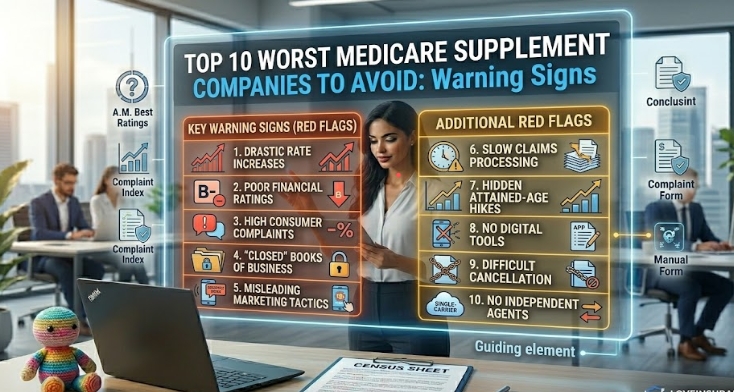
Memorizing a specific list of bad carriers is the wrong approach. If you are searching for the top 10 worst medicare supplement companies, it is crucial to state that such assessments are subjective and depend on diverse perspectives. A company that failed one senior might work perfectly for another. Instead of looking for a ranking, you should evaluate providers neutrally based on concrete data and historical behavior. Here is the direct breakdown of the 10 critical red flags that indicate a Medigap provider you should avoid in 2026.
10 Red Flags of a Poor Medicare Supplement Provider
To protect your retirement savings, avoid any insurance carrier that exhibits these ten warning signs:
1. A History of Drastic Rate Increases
Medicare Supplement (Medigap) plans are standardized by the government, meaning Plan G from Company A has the exact same medical benefits as Plan G from Company B. The only difference is the price. The worst companies lure seniors in with rock-bottom initial premiums, only to hit them with 15% to 20% rate increases year after year.
2. Poor Financial Strength Ratings
Never buy a lifelong policy from a financially unstable company. If an insurer has a rating lower than “B+” from rating agencies like A.M. Best or Standard & Poor’s, it is a massive red flag.
3. High Volume of Consumer Complaints
You can check a company’s National Complaint Index Report. Companies that consistently score higher than the national average for complaints regarding delayed payouts or denied claims should be immediately disqualified from your search.
4. “Closed” Books of Business
Sometimes, a carrier stops accepting new applicants for a specific block of policies but continues to service the old ones (a closed book). Without healthy, new premium dollars coming in, the rates for the existing older, sicker members skyrocket.
5. Aggressive or Misleading Marketing Tactics
If a company utilizes high-pressure phone tactics, unsolicited door-to-door sales, or confusing mailers that look like official government documents, walk away. Reputable carriers rely on their financial track record, not trickery.
6. Extremely Slow Claims Processing
Seniors on a fixed income cannot afford to wait months for a medical bill to be resolved. The worst companies use outdated, manual systems that delay standard Part B excess charge payouts.
7. Lack of Attained-Age vs. Issue-Age Transparency
There are three ways Medigap policies are priced: Community-rated, Issue-age-rated, and Attained-age-rated. A bad company will not transparently explain that an “Attained-age” policy will automatically get more expensive every single year simply because you are getting older.
8. No Digital Self-Service Tools
In 2026, a lack of a secure, easy-to-use online portal to check claims, download replacement ID cards, or pay premiums is unacceptable and indicates a lack of investment in customer experience.
9. Difficult Cancellation Processes
If a company makes it intentionally difficult to cancel a policy or transfer to a different carrier by imposing hidden fees or requiring excessive paperwork, they belong on your “avoid” list.
10. Refusal to Work with Independent Agents
Captive agents only sell one company’s products. If an insurance carrier refuses to distribute their plans through an independent insurance broker, it often means their prices are not competitive enough to survive a side-by-side comparison.
The Verdict
Protecting your healthcare in retirement requires due diligence. Because evaluating the top 10 worst medicare supplement companies relies heavily on subjective experiences, your best defense is data. Always check a carrier’s financial rating, review their complaint history on official state department websites, and consult with a licensed advisor before signing an application.
Frequently Asked Questions (FAQ)
Where can I find official complaint data against Medicare Supplement companies?
You can find neutral, objective complaint data and investigate an insurance company’s track record through the National Association of Insurance Commissioners (NAIC) database.
Are all Medigap Plan G policies exactly the same?
Medically, yes. Federal law dictates that the medical coverage provided by a Plan G must be identical regardless of which company sells it. The only differences are the monthly premium you pay, the company’s customer service, and their history of rate increases.
Can I switch my Medicare Supplement company if I don’t like them?
Yes, but with a major catch. If you are past your initial 6-month Medigap Open Enrollment Period (which starts when you turn 65 and enroll in Part B), you will likely have to answer medical underwriting questions to switch. If you have developed serious health conditions, a new company can legally deny you coverage.

Lead Researcher & Founder at LoveInsurance.biz. With an academic background in law (class of 2017), Nicolas specializes in deconstructing complex contract clauses and insurance policies, transforming legal jargon into clear, actionable advice for everyday consumers.